
Lunenburg Scheduled Versus Actual Release
VADOC labels the public field Release Date. When it lies in the future on an imprisoned record, it is a forward-looking sentence computation. It may change. The actual release is the later operational event recorded by the custodian.
A pretrial detainee at PRJ usually has no sentence-based release date. Bond, a court order, dismissal, another hold, or case progress can determine the next event. An ordinary local sentence also should not be forced into the public VADOC calculation unless VADOC has authority for that sentence.
PRJ is in Farmville and serves Lunenburg as a regional jail. Lunenburg Correctional Center in Victoria is a VADOC state prison. Their date channels are not interchangeable. PRJ Records and the sentencing court answer an ordinary local term, while VADOC computes a state-responsible sentence and publishes its own field.
Find Lunenburg Release Dates
Start with the person's last known custody and use the source that computes or records that custody.
- For a state prisoner, open the VADOC Inmate & Supervisee Locator.
- Search by seven-digit DOC ID or by the required name fields and match identifiers.
- Read Location and the exact Release Date label together. A prison and future date mean continued confinement.
- For a PRJ detainee or local sentence, read the sentencing or bond order and contact PRJ Records.
- For parole, use the Board decision as authorization evidence, then verify the later movement in VADOC.
- For a fully discharged person outside the locator scope, request the VADOC register or historical record and court judgment.
The public locator updates daily and can be stale. A District Office location supports prison exit to supervision, not full discharge. A different prison location is a transfer.
When a result belongs to Lunenburg Correctional Center, record the displayed institution and exact Release Date label. Do not rename the field “guaranteed date.” If the result later shows another VADOC prison, the person transferred. If it shows South Boston District 8 or another community setting, institutional custody has ended but VADOC supervision continues. If the person disappears after full discharge, a formal VADOC record and the sentencing judgment become the stronger historical route.
The official search view below comes from the VADOC locator.
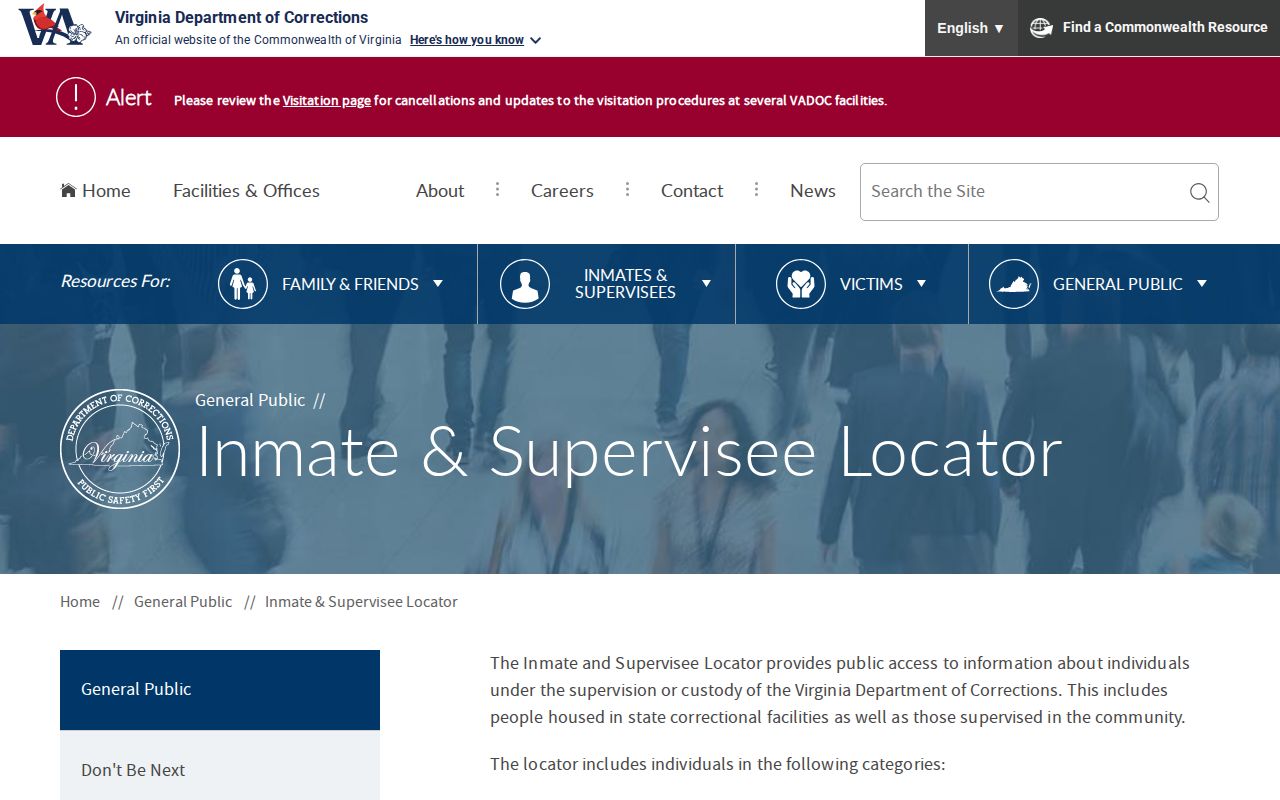
Use both the location and date to avoid reading a transfer or supervisee result as complete release.
Lunenburg Time Computation Channels
VADOC says local or state authorities compute release dates depending on sentence type and active time. State-responsible cases belong in VADOC's system. Ordinary local terms remain with the jail and sentencing court.
| Custody situation | Date source | Key limit |
|---|---|---|
| PRJ pretrial custody | Court orders and PRJ status | No fixed sentence date may exist |
| PRJ local sentence | Sentencing court and PRJ Records | Do not assume VADOC credit treatment |
| VADOC prison | Locator and time-computation record | Future Release Date can change |
| Community supervision | VADOC location and discharge record | Prison exit is not full discharge |
| Federal sentence | BOP locator and federal judgment | Not a Virginia jail computation |
Questions about a VADOC calculation can be directed to VADOC, ATTN Correspondence Unit/Court & Legal Section, P.O. Box 26963, 6900 Atmore Drive, Richmond, VA 23261. The official time-computation page explains the controlling systems.
Its source display is reproduced below.
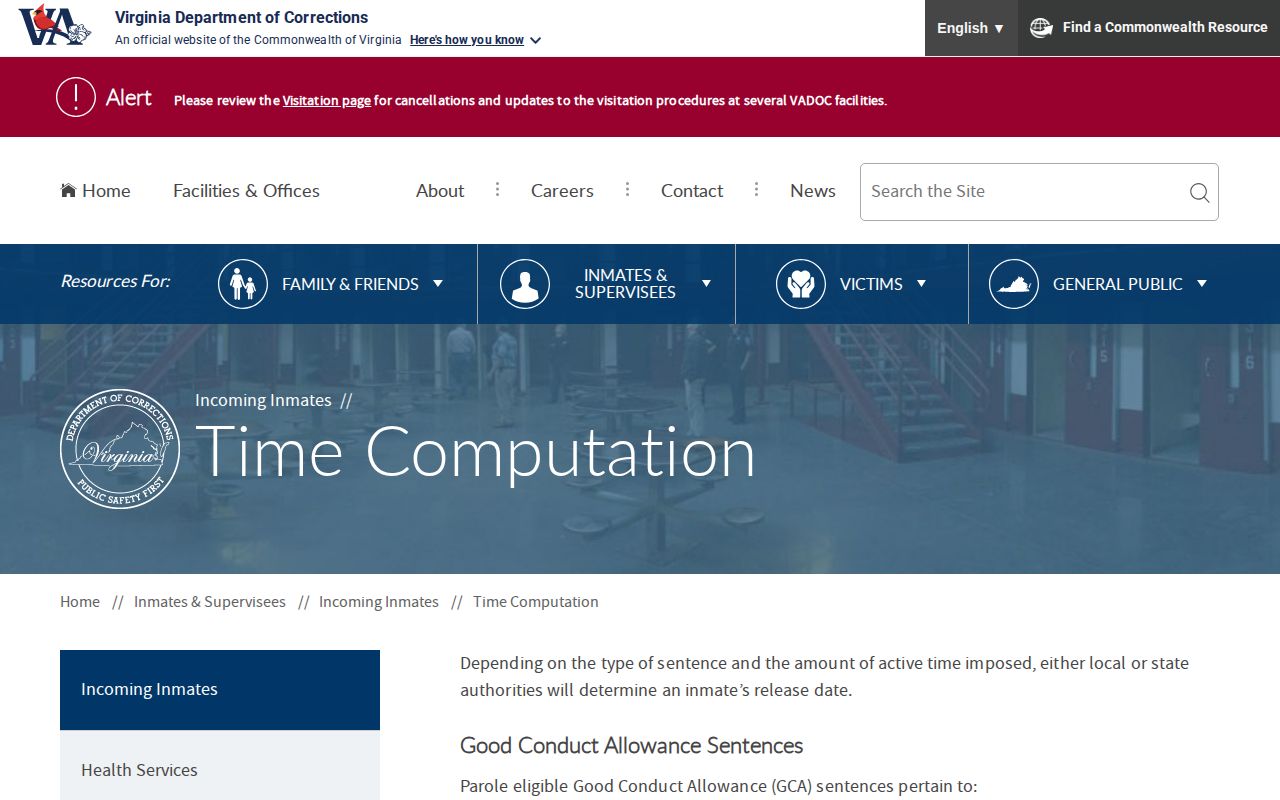
The page identifies computation variables, not a personal guarantee.
Lunenburg Earned Sentence Credits
Felony offenses committed on or after January 1, 1995 generally use Earned Sentence Credits. Virginia Code §53.1-202.2 defines one credit as one day deducted and applies the framework in state or local correctional facilities.
Under current §53.1-202.3, enumerated ESC-1 offenses earn no more than 4.5 days per 30 days served. Eligible ESC-2 offenses can earn by level: Level I 15 days, Level II 7.5, Level III 3.5, and Level IV zero. Conduct and program criteria affect the level. Section 53.1-202.4 authorizes rules and forfeiture criteria.
The familiar 85 percent shorthand describes the 4.5-per-30 framework for many truth-in-sentencing cases, but it is not universal. Enhanced credits apply to eligible offenses, while excluded offenses remain capped. Jail credit, earning level, disciplinary events, and sentence changes can move the date.
The offense date matters because Virginia has more than one sentence-credit system. The exact offense, statutory eligibility, sentence combination, and earning level must be checked. A broad percentage can miss excluded offenses, enhanced-credit eligibility, jail credits, or later forfeiture. The official computation remains controlling.
The statutory source below comes from the official earned-credit eligibility law.
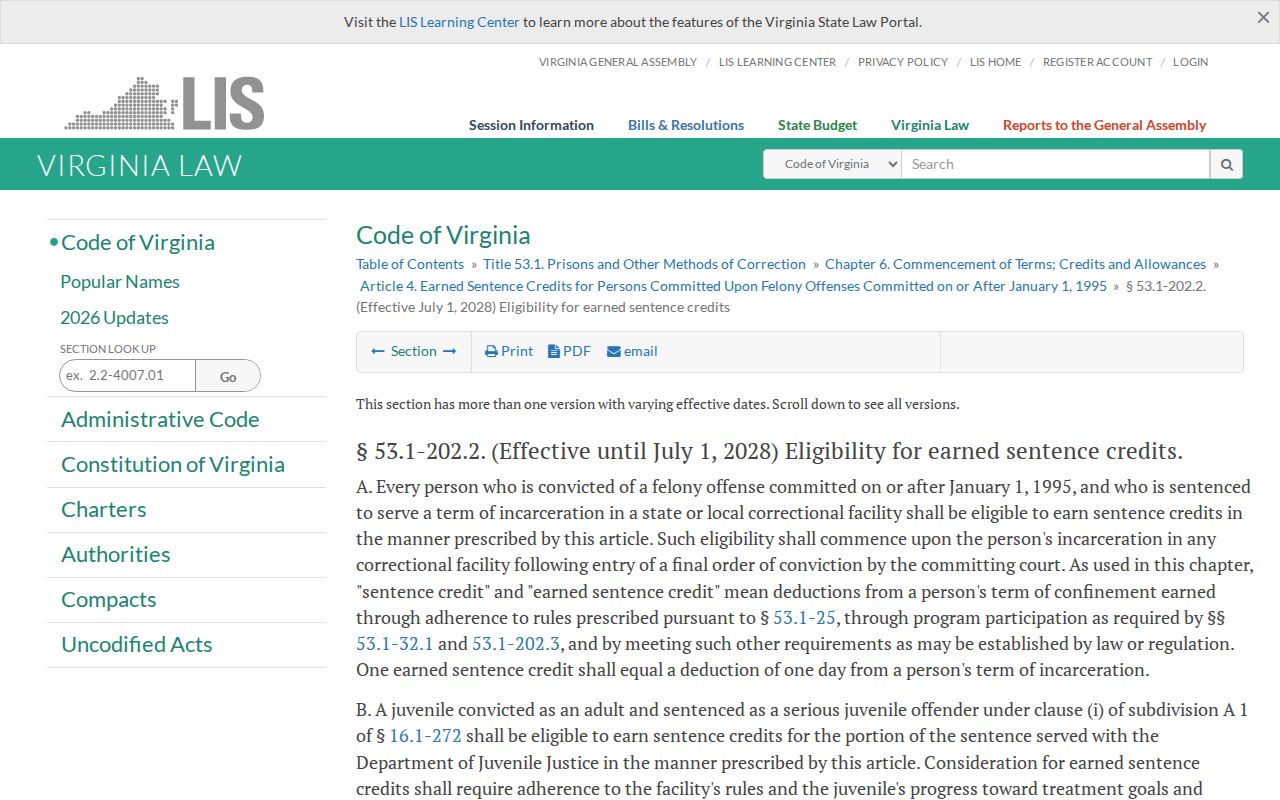
Eligibility must be tied to the actual offense and sentence, not a broad percentage.
Lunenburg Good Conduct Allowance
Older cases can use a different system. Felonies committed before January 1, 1995 and misdemeanors before July 1, 2008 may fall under Good Conduct Allowance. When active sentences total more than twelve months, VADOC computes discretionary-parole eligibility, mandatory-parole release, and good-time dates.
GCA class rates range from zero to 30 days credited per 30 days served under Virginia Code §§53.1-198 and 53.1-202. The person's class and conduct history matter. These older rules should not be mixed with ESC levels.
VADOC may calculate discretionary-parole eligibility, mandatory-parole release, and good-time release dates when the qualifying active sentence exceeds twelve months. Each date answers a different legal or administrative question. A parole-eligibility date permits consideration under the applicable rule; it is not a release order. A good-time calculation reflects the credit system and conduct history. The actual movement remains subject to current orders, holds, and VADOC operations.
Note: Credits affect a calculation, while another charge, detainer, or receiving authority may still prevent community release.
What Changes Lunenburg Release Dates
A displayed date can move for lawful reasons. The exact record should identify which authority changed it.
Changes should be documented by source and date. If a new court order modifies the term, the court explains the legal change and VADOC applies it. If an earning level changes, corrections records control that computation. A mismatch is a reason to contact the responsible office, not to select whichever date is earlier.
| Factor | Possible effect |
|---|---|
| Jail credit | Changes credited time already served. |
| Earned-credit level | Changes the rate applied to an eligible sentence. |
| Disciplinary event | Can reduce earning or cause forfeiture under the rules. |
| New or amended order | Changes the sentence the agency must compute. |
| Detainer or hold | May cause transfer rather than community release. |
| Parole action | May authorize a conditional transition after later processing. |
A future date approaching on the locator is not a countdown. Verify that the person remains at the same institution, check the current computation rules, and confirm an actual event through the responsible agency.
A detainer deserves special care. It may cause one facility to end custody while another authority begins custody. The first agency's date can be accurate without describing community release. Check the receiving agency named in the transfer record before arranging travel or reporting that every correctional obligation ended.
Sentence combinations can also change which authority computes time. VADOC notes that misdemeanors committed after July 1, 2008 are not parole eligible and generally are not calculated by VADOC unless combined with state-responsible sentences. That makes the Lunenburg sentencing order and PRJ Records essential for an ordinary local term. Applying a state-prison credit rate to a county-jail booking without checking the sentence can produce a false date.
Lunenburg Parole Date Limits
Virginia Code §53.1-165.1 generally abolished discretionary parole for felony offenses committed on or after January 1, 1995, but current law includes exceptions. These include specified older sentences and qualifying cohorts. An old blanket statement that Virginia has no parole is inaccurate.
For parole-eligible cases, the Board decision is not the gate date. Planning, certification, and notice can follow. A VADOC District Office result later supports community supervision. The VINELink Release Check applies to PRJ custody events, while eligible state-prison notifications use separate NAAVI registration.
Eligibility depends on offense and sentence. Current law retains categories involving older crimes and specified later exceptions, including some jury-sentence and juvenile-offense cases. For an eligible sentence, §53.1-151 supplies different first-eligibility fractions and caps, plus special life-sentence treatment. Credits do not simply erase the required eligibility time.
The Board's monthly report is delayed and should be read as a decision source, not a same-day release feed. A grant needs later VADOC confirmation. If the locator still shows a prison, institutional custody continues even though the Board acted.
Confirm Lunenburg Actual Release
For PRJ, call Records at 434-392-1601, extension 732, and request the existing release date and time, disposition, and receiving agency. For state custody, compare the VADOC location, formal record, and court judgment. For a parole case, add the Board decision without confusing its date with movement.
Ask a narrow question. For a local sentence, provide the case number, booking identifier, and sentence date. For VADOC, provide the seven-digit DOC ID when known and identify the exact displayed field that needs explanation. A specific request helps the agency find the relevant computation record and reduces namesake errors.
A release from one facility can be a transfer. The Lunenburg County release-record process maps the jail, court, VADOC, federal, and immigration sources. No adult lookup should be used to seek restricted juvenile release information.
For historical proof after complete discharge, request VADOC prisoner-register information and the court judgment. Virginia Code §53.1-24 requires a register describing the sentence, offense, and receipt. It can remain useful when the public locator no longer covers the person.
Record the date the locator was checked and save the exact field label. If the date later changes, those details let VADOC explain the computation without confusing a prior display with an actual release event.
Use the current statute and agency guidance each time. Credit rules and parole exceptions can change, while an old saved explanation may no longer match the law applied to the sentence.
The same evidence rule applies when two public dates appear to conflict. Keep the sentencing-order date, Board-decision date, displayed Release Date, and actual custody event under separate labels. Ask the court about its order, VADOC about sentence computation, and PRJ about a local booking. None of those offices controls the whole sequence. A clear timeline can show that each source is accurate for its own event even when the dates do not match.
Note: The strongest proof pairs an affirmative release event with the legal disposition and a check for any receiving custodian.